





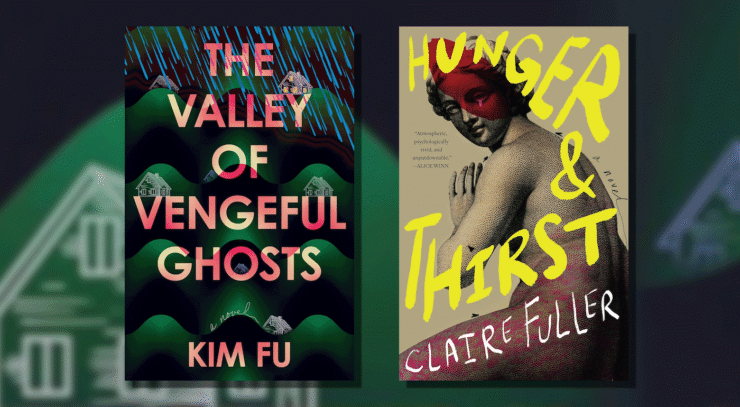
The first sentences of Claire Fuller’s sixth novel, Hunger and Thirst, introduce a murder, a missing body, and “the Underwood,” an ominous house with a sofa in the back garden. In 1987, Ursula, a sixteen-year-old who has spent most of her childhood in the state care system, gets a job in the mail room of a local art school. She befriends her coworker Sue, an aspiring filmmaker and outspoken feminist, and is invited to join a squat at the Underwood. Sue and Ursula’s friendship is barbed and intense, with the desperate longing and callousness of teenagers. Their collision draws out the dormant horrors of the house, escalating to a tragedy that haunts Ursula for the rest of her life.
I have been a fan of Claire’s work since before I knew we shared an editor, the brilliant Masie Cochran. I’d referred to her earlier books as the inspiration for my 2026 novel, The Valley of Vengeful Ghosts, and was amazed to learn that we were both releasing books about haunted houses in the same season. Hunger and Thirst blew me away. I tore through it, entranced, staying up two nights in a row.
Claire spoke to me by Zoom from a hotel room on her UK tour, on the book’s publication day in America.
Kim Fu: I first want to ask about the structure of the novel in relation to time—the book is written from the perspective of 52-year-old Ursula in 2023, looking back at 16-year-old Ursula in 1987, and the terrible events that will lead to murder. I’m in the middle of Anne Carson’s Eros right now, and she talks about the pleasure of this kind of dual perspective, possible in art but impossible in life: immersed in scene with past Ursula, with the foreboding and hindsight of future Ursula. You used a similar reflective-narrator-from-the-future in your third novel, Bitter Orange. What draws you to this structure? What does it allow you to do that linear time would not?
Claire Fuller: I can’t remember why I did that in Bitter Orange. There must have been a good reason. [laughs] With Hunger and Thirst, I started writing it from teenage Ursula’s point of view. But she’s 16, and she hasn’t had a great education, and I found I wanted to be able to write in more sophisticated language than she would use. This structure also allows me to include her reflections, some of the emotional impact of what happened that has carried through the years.
Once I decided that she was going to be older looking back, I needed a reason. Why now? Maybe the police have found new evidence, or a journalist has decided to investigate. And then it seemed right that it would be a true crime documentary, because film is so important in the novel.
My writing is often a response to challenges I’ve set myself. Rather than thinking, “Oh, I quite like this technique,” or “this structure is cool,” it’s more like, “Oh shit. I’ve got this issue. How am I going to solve it?”
KF: That’s the fun of writing, right? The perpetual problem solving. Since you mention the documentary—snippets of which punctuate the book, as well as the documentarian pursuing Ursula for an interview, and her fears about what might be revealed—what are your feelings about true crime as a genre? Are you a fan of it? I found, as I was reading, I was sympathetic to Ursula’s perspective on the filmmaker as self-aggrandizing, or exploitative, or only loosely interested in the truth.
CF: It is a guilty pleasure. I do enjoy listening to it, reading it, watching it, but I’m aware of that issue. Especially when the victim is not involved—those are the worst. It can feel very exploitative, entertainment at the expense of someone’s trauma. And even when they are involved, the documentarian still has an agenda. They have their own bias. They want to produce something that is page-turning, gripping, that we want to keep watching, and sometimes that will be at the expense of the people being interviewed. I’m quite interested in true crime—in how I love it, and how I feel guilty about it.
KF: The book does a great job of exploring that tension. That’s something that used to stress me out about nonfiction writing in general. You’d feel an aesthetic desire pulling you in one direction, but then you’d have to ask, is that the most truthful? Is that truest to the facts, or is that just the best story? I should say, I don’t write very much nonfiction anymore.
CF: And you don’t feel that pressure in writing fiction?
KF: Much less so. In fiction, we’re much freer to follow our aesthetic desires, and also to pursue emotional truths. You’re beholden to the characters and the way things feel, but not a set of preexisting facts and events. And, actually, in the case of the kind of writing both of us do, we’re not even beholden to realism or the laws of physics.
I wanted to ask you about that, too. Across six novels, you’ve established yourself as wonderfully impossible to pigeonhole—in conversation and lineage with horror and apocalyptic fiction, certainly, but also expansive and liminal in genre. In Hunger and Thirst, there’s direct reference to classic horror films; Sue wants to become a horror director. There are shambling corpses rapping at the window, inexplicable music, powerfully frightening images and sequences. What is your relationship to genre, as a writer? Is it a useful framework, is it something you ignore?
CF: I don’t think about it when I’m writing. I’m never thinking, “this is a horror novel.” Or if I am, I’m thinking, “Oh dear, this is a horror novel, and my other novels weren’t horror novels, and my publishers are going to think, ‘Oh no, we have to find a whole new audience for Claire.’” It’s less complicated for me as a writer. Like you said, as fiction writers, we can go anywhere. But when the book is out in the world, when the publishers are trying to find an audience, I think it becomes more complicated, because there are expectations from readers based on what they’ve read of mine before. What they’re expecting for the next book, they very rarely—well, so far, never—get it. My publishers have continued to buy my books, so I guess it can’t be too much of a problem. [laughs]
I don’t think about genre in terms of where it’s going to sit on a shelf in a bookshop. But maybe I think about it in terms of the tropes that you might find in horror, like the tapping at the windows, the unexplained music, the flies, and try to be aware of them, and use them to my own ends as the novel requires, and try not to make them cliches, try to make them fit naturally into the story.
What about you? Do you think about genre? Do you think of your book The Valley of Vengeful Ghosts as a horror novel?
KF: Similar to you, I don’t think about it when I’m writing. I think Valley plays with a lot of horror tropes and the rhythms of horror while ultimately not being that scary, not really functioning as horror. I agree it’s a complex problem, in terms of marketing and reader expectations, where it gets placed on a shelf, but I don’t feel like it’s helpful for me to feel penned in by saying at the outset “I’m going to write a horror novel,” as opposed to thinking of it an infinite toolbox I’m allowed to play in.
CF: Absolutely. I read all my reviews, and there are some horror readers already saying, “Nothing happens in the first half! It’s so slow! Where’s the scary stuff? The pacing is off. It suddenly ramps up in the second half.” And I’m strong enough now to think, “Well, that’s deliberate on my part. It may not fit the genre perfectly.” It’s interesting you say Valley isn’t scary—I had so much anxiety reading it, in the best possible way.
KF: I often cite you as an influence because of the slow burn. I think of you in the tradition of Shirley Jackson and Daphne du Maurier, who we call horror now, but I think if they published today, we might not. It’s more like, boiling slowly in tension. There’s a point in Hunger and Thirst when you look up and you’re shocked to find yourself in the midst of such intense horror, even as each step feels earned and inevitable. Who are your influences?
CF: Shirley Jackson, yes, hugely. The Haunting of Hill House and We Have Always Lived in the Castle are two of my favorite novels.
KF: Me too!
CF: Scary things happen, but they’re character-led. We get characters first, and then the tension builds. There’s a novel called Idle Grounds by Krystelle Bamford—I can’t remember when I read it; it might well have been after I finished writing Hunger and Thirst, but it suits what I was trying to do, and the style of writing that I like. It creeps up on you and becomes very weird. I’m not sure about influences on this novel specifically. I read a lot, I read all the time, and it all soaks in, rather than, “Oh, I’m going to go out and read horror, because this is the kind of book I’m writing.” It doesn’t work like that for me.
KF: What about in general? Who inspired you to want to be a writer when you were young?
CF: I didn’t want to be a writer when I was young. I’ve always been a reader, but it never occurred to me to be a writer until I was forty. That’s when I started writing, and when I wrote my first novel. And it was, actually, We Have Always Lived in the Castle. I read it several times. I thought, I can see what she’s doing, but how is she doing it? I was also reading Barbara Comyns, a British author who wrote in the 50s and 60s. I really like her style of writing.
KF: Ursula works in the mail room of an art school, which leads to her eventual career as a renowned sculptor. I loved the descriptions of her pieces, especially her first one in the garden of the Underwood, and her most famous, the enormous grotesquerie The Lithopedion. They’re so memorable and disturbing. I saw that you studied sculpture in school yourself. Can you talk about the significance of Ursula being an artist, and a sculptor in particular?
CF: This is the first book where I’ve used a lot of my own life. I’m in no way Ursula, but the setting is based on Winchester, which is where I went to art school. I was there in 1987. Even the house that Ursula lives in, the squat, is a house that I lived in; it is based on a real house. Once I’d decided that Sue was going to be a filmmaker, I wanted both these women to be artists, trying to make it work.
I wanted Ursula to have some success much later in life, but also to have had such a difficult life that she has to hide away, be reclusive. And in the work she makes, she keeps drawing and sculpting the same subjects, dealing with the things that happened when she was sixteen.
KF: Does her process as a sculptor relate to yours as a writer?
CF: There are similarities between carving and writing. But maybe that’s just me, because I was a sculptor and now I’m a writer. I don’t know if you have this, but I have the idea of the book in my head, and it’s perfect, it’s absolutely amazing. And then when it comes out, onto the page, it’s nothing, compared to what was in my head. And sculpting was much the same. I would have some grand image, but something was lost in the transfer from my head to the medium. But after you’ve blocked out the sculpture, or you’ve written your first draft, the piece is created in the editing, refining, the polishing, the going over, the tiny changes, the months of iterative work.
And—let’s say you’re editing, and you take out one small thing. That change turns out to be enormous, consequences rippling throughout the novel. In carving, you change one thing on one side, and because you’re working in three dimensions, it changes everything. Books feel very three-dimensional to me.
KF: I relate to that a lot. Both what gets lost in translation between the vision and the first draft, and also that the work truly emerges through editing and refining, those unexpected downstream effects.
At one point Ursula says of a sculpture that it isn’t “hungry enough.” Throughout the book, she has a tortured relationship to food. She has traumatic experiences with starvation, but is unable to eat when presented with an abundance of food by Sue’s family, who (at least for a time) feed other needs and desires. The ghost—monster?—is notably, chillingly, always thirsty, always begging for a glass of water. When and how in the process did you land on the title? What does it mean to you?
CF: The title came quite late in the process. I’d already written the scene where Ursula is trapped in a bathroom in Morocco and is really hungry and thirsty, the significance of which is threaded through the novel. As you say, she eats when she’s unhappy, and she can’t eat when things are going well. I started thinking about hunger and thirst in other ways as well. To be hungry is to want something, to be looking for something, but thirst is a requirement, a need, something more fundamental. You can survive without food for a longer time than without water. I was thinking about that for all of the characters: what are they hungry for, what do they desire? And what do they thirst for, what do they actually need? Ursula is hungry for a family, that’s what she would say she wants, but what she needs is to belong.
KF: The abandoned house where Ursula goes to live with Vince, the Underwood, fails to be a home twice. It was already the site of a violent domestic tragedy, before the hauntings infect Ursula and her friends. As a child, Ursula has been in and out of institutions and foster homes, until she breaks her own arm to demand escape. Without spoiling the details, much later in life, when she finally is able to buy a home of her own, it also goes terribly, terribly awry. What draws you about these un-homey homes, home as the place where the worst happens?
CF: Place is really important in all of my novels. And homes are great for creating atmosphere. They end up having a life of their own; they become characters. I’m interested in places where people have lived and then gone, perhaps died or just left, and what effect that has on the people who live there next. Does the idea or the atmosphere of the previous inhabitants linger?
Ursula is desperate for a home she can call her own. And yet, I think the reader probably knows from the beginning that the Underwood is an awful house, and she’s probably better off staying where she was. So there’s already tension, in that ghost-story way. As in, “Don’t go in the house! Don’t go in there!”
Kim Fu is the author most recently of The Valley of Vengeful Ghosts (Tin House/Zando).
Claire Fuller is the author most recently of Hunger and Thirst (Tin House/Zando).
